§ News ·
Talk at CCPBioSim2026 in Bristol
Kirill spoke about the surprising advantages of physics-based ML/MM potentials at the CCPBioSim annual conference in Bristol.
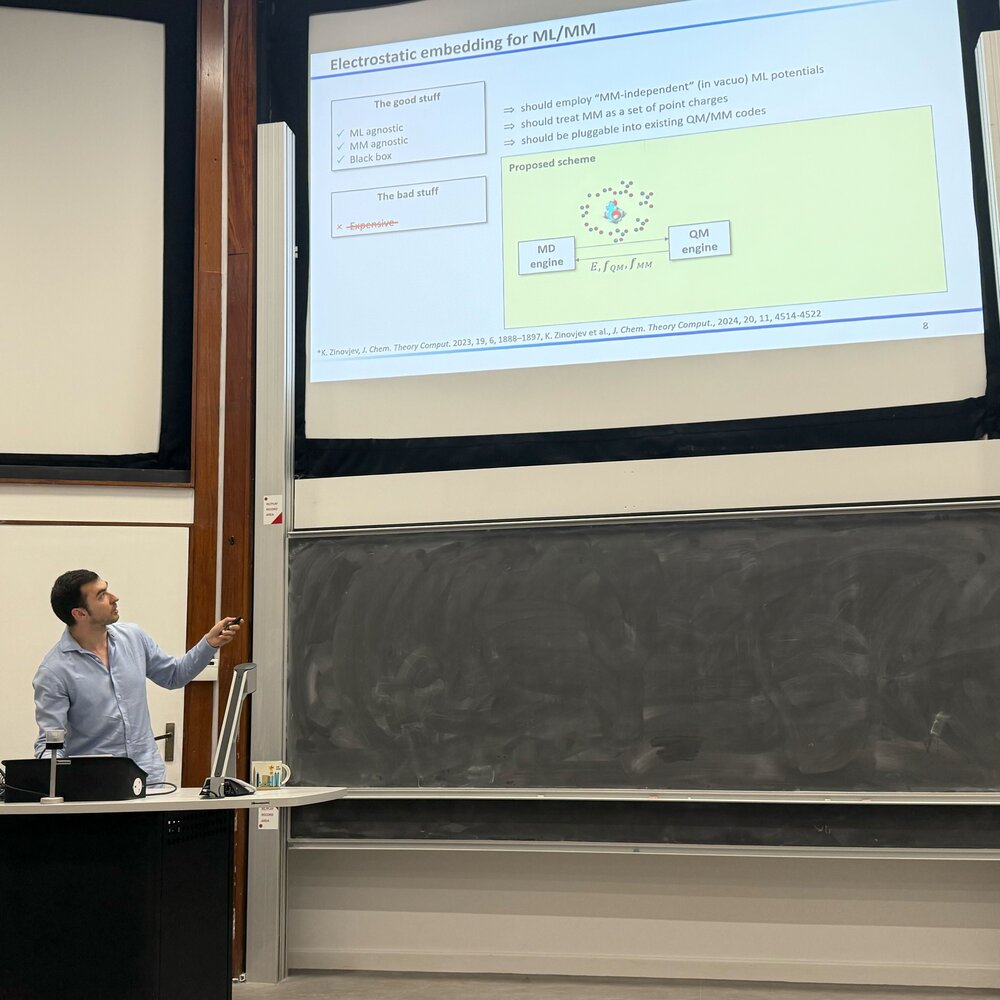
Kirill gave the talk Surprising advantages of physics-based ML/MM potentials at the 12th annual CCPBioSim conference, Frontiers in Biomolecular Simulation, held at the University of Bristol from 6 to 8 July.
The talk presented the electrostatic machine learning embedding (EMLE) scheme. Instead of fitting QM/MM energies, EMLE uses physical models of electron density and polarizability to describe how the ML region responds to its environment. Trained only on gas-phase data, EMLE models transfer well to new environments and do more than reproduce QM/MM: they predict Raman spectra, avoid the charge spill-out problem of QM/MM, and enable enhanced sampling methods that standard QM/MM or naïve ML/MM potentials cannot support. The talk included results from our recent paper on enzyme catalysis.